
Probability Matrix
Advanced mathematical tools for simulated table-game environments, applying structured statistical models to number sequences and card patterns.
Our Probability Matrix modules apply proven mathematical theories - including Fibonacci sequences, Kaprekar constants, palindromic patterns, and Hi-Lo card counting - to analyse probability distributions in environments such as roulette (a pseudo-random-number-based wheel simulation) and blackjack card sequences. Each module is designed for use alongside live dealer tables, applying structured statistical analysis to support accuracy and a disciplined capital recovery workflow.
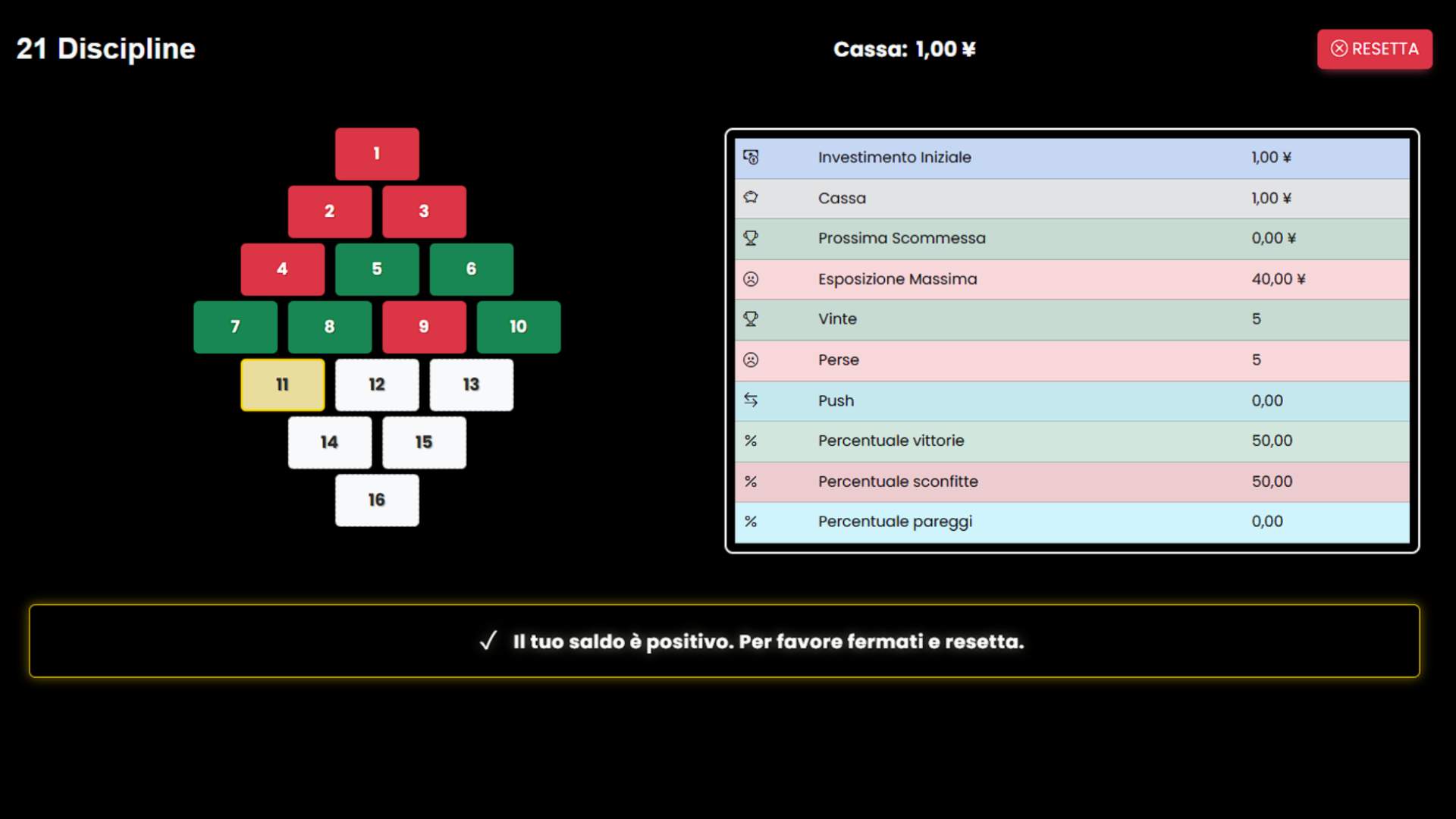
21 Discipline
A structured staking progression for blackjack, built to help you recover without blind doubling.
21 Discipline is a staking progression designed for blackjack sessions. Rather than tracking cards or predicting outcomes, it adjusts your next stake after each hand based on your current balance, guiding you through a structured sequence aimed at working back toward zero — without resorting to uncontrolled doubling strategies like Martingale.
Main Features
- Balance-Based Staking: Adjusts your next stake according to your current balance, not blind repetition.
- Controlled Progression: No uncontrolled doubling — every step follows a structured, capped sequence.
- Hand Outcome Tracking: Records win, lose, push, blackjack, double, and split outcomes to keep the sequence accurate.
- Real-Time Balance View: See your current position and next suggested stake at a glance.
- Stop-Win & Stop-Loss: Configurable limits to protect gains and prevent chasing losses.
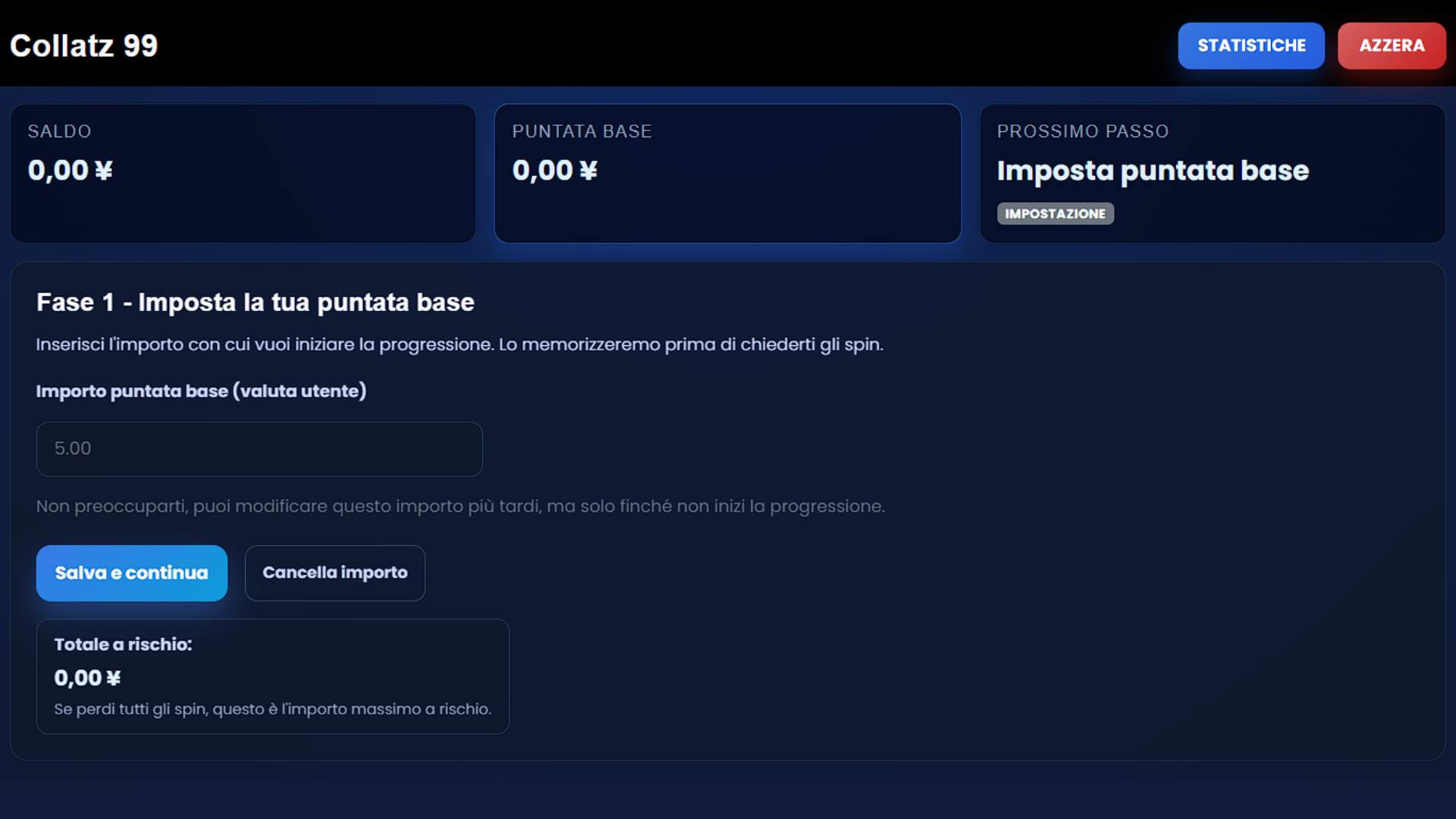
Collatz 99
A staking sequence inspired by a mathematical conjecture that always converges to baseline.
Collatz99 is a roulette staking system inspired by the Collatz conjecture — the mathematical theory that any sequence of numbers, however complex, will always converge back to 1. Applied to even-money roulette, this principle inspires a structured staking sequence designed to systematically pursue loss recovery and build a cumulative positive balance over time — with no blind doubling. As with all staking systems, this manages how you allocate stakes across outcomes; it does not change the underlying odds of the roulette wheel itself.
Main Features
- Collatz-Inspired Sequence: Staking logic inspired by the famous mathematical conjecture for structured play.
- Convergence-Based Recovery: The sequence is designed to work back toward a baseline, following the conjecture's structure.
- Even-Money Focus: Optimised for even-money roulette bets — red/black, odd/even, high/low.
- Automatic Next-Stake Calculation: The software computes every step in the sequence without manual effort.
- Session Archive: Logs every sequence and its outcome for long-term performance tracking.
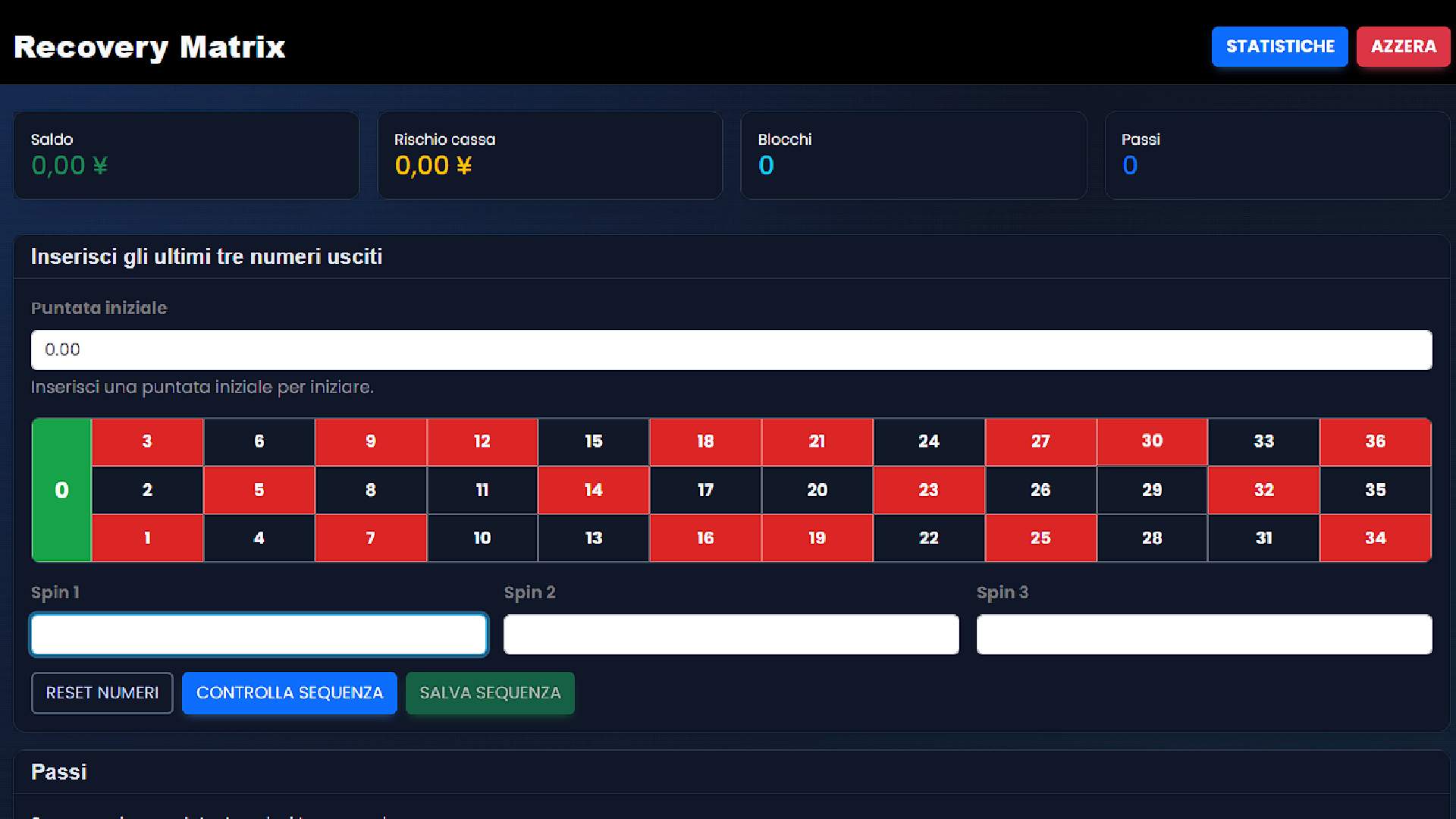
Recovery Matrix
Systematic roulette recovery built on mathematical precision.
Recovery Matrix adapts the proven recovery-tracker methodology to the roulette table. Using a structured mathematical sequence across progressive betting blocks, it helps players manage losing streaks on even-money outcomes, recover lost capital in a disciplined way, and protect the bankroll from sharp drawdowns.
Main Features
- Roulette-Optimised Recovery: Sequence calibrated specifically for even-money roulette markets.
- Progressive Block Structure: Divides recovery into manageable blocks to avoid over-staking.
- Horizontal & Vertical Recovery: Offers both same-block and cross-block recovery options.
- Bankroll Protection: Amortised staking logic limits exposure during extended losing runs.
- Session Log: Full record of every spin, stake, and outcome for post-session analysis.
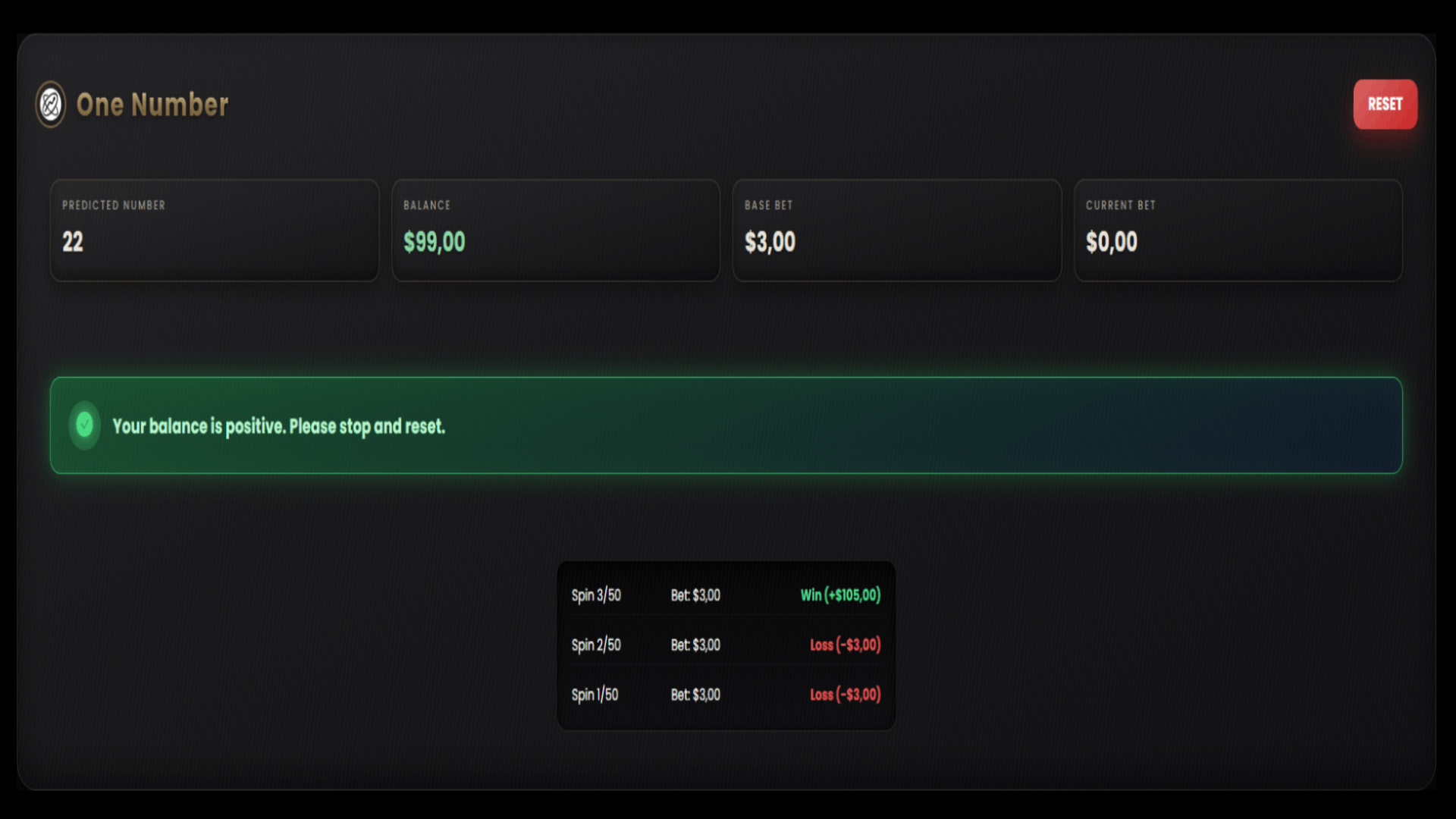
One Number
A statistical model that analyses the last 37 spins to select a single number for a structured, risk-capped staking sequence.
One Number is a straight-up roulette staking system built around live spin-sequence input. You set your base stake, and the software immediately calculates the total capital at risk so you always know your exposure before you start. You then enter the last 37 numbers from the live wheel; the algorithm applies its configured criteria to the sequence and generates a single-number selection. Note that each spin of a roulette wheel is an independent event — past spins do not change the odds of future ones. The suggested stake is then applied to that number for up to 50 steps, with the software adjusting the bet size along the way according to its staking rules.
Main Features
- Live Sequence Input: Enter the last 37 spins directly from the table to feed the algorithm.
- Single-Number Focus: Analyses straight-up outcomes rather than even-money groups.
- Upfront Risk Calculation: Shows the total capital at risk before you place a single bet.
- Adaptive Stake Sizing: Automatically adjusts the bet across the sequence according to its configured staking rules.
- 50-Step Cap: Every sequence runs for a maximum of 50 steps, then resets.
- Session Archive: Logs every spin, stake and outcome for review.
Red Carpet
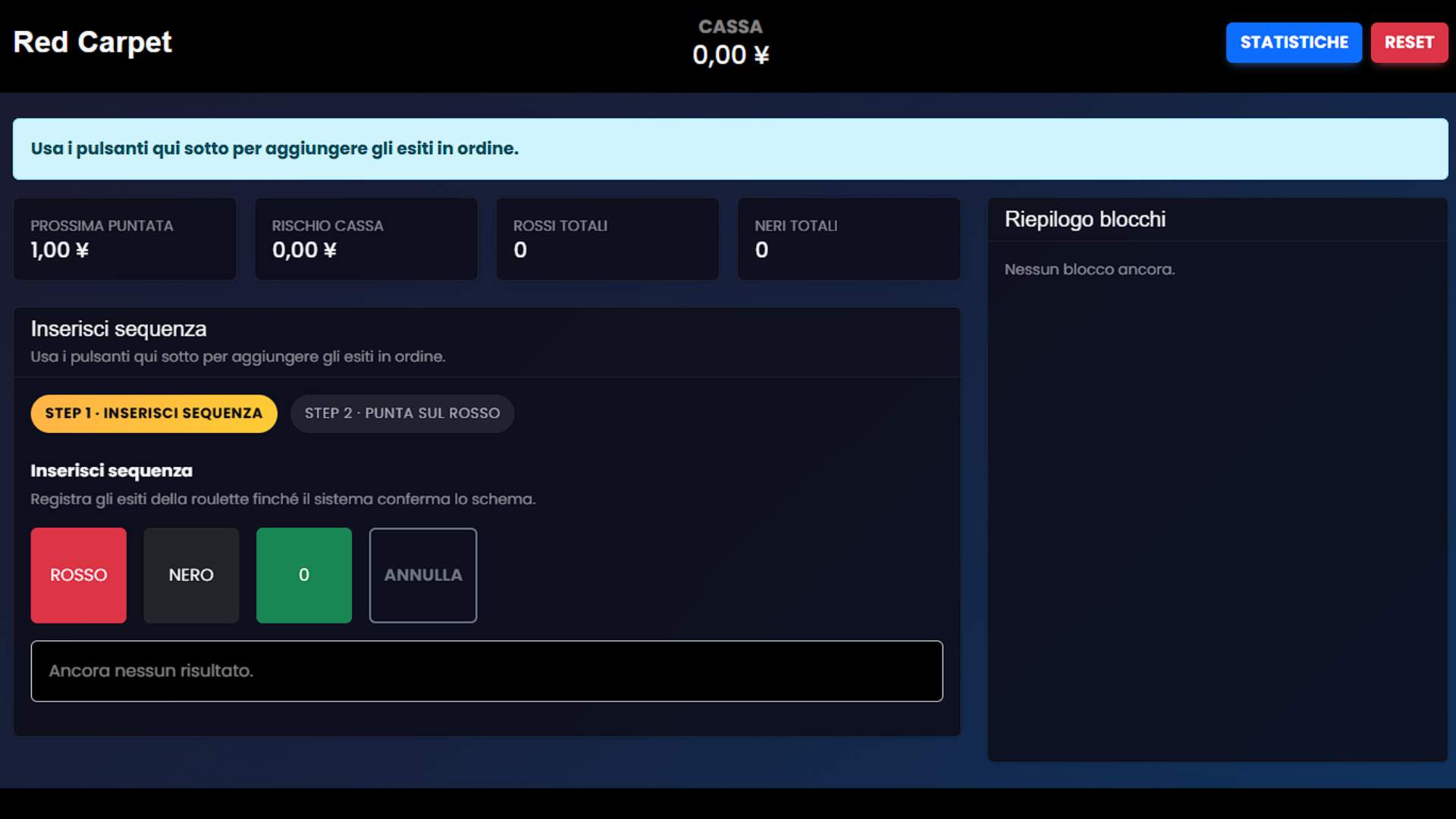
A structured staking approach for red, built on mathematical trigger logic.
Red Carpet uses mathematical logic — including palindromy and Kaprekar's constant — applied to the recent spin sequence to trigger a structured entry on red. Rather than betting randomly on colour, the system applies a dampened progression method to limit losses and a rules-based trigger system to time entries consistently. As roulette spins are independent events, the trigger governs staking discipline and timing, not the underlying odds of the wheel.
Main Features
- Mathematical Foundation: Based on palindromic patterns and Kaprekar's constant.
- Targeted Event Area: Focuses exclusively on the colour red for a consistent, structured approach.
- User Interaction: Minimal input needed, with clear instructions during gameplay.
- Risk Management: Uses a dampened progression method to limit losses.
- Automated Adjustments: Adapts bet amounts in real-time based on past events.
Wheel Engine 30
Bonus-aware roulette progression that recommends numbers and tracks your risk in real time.
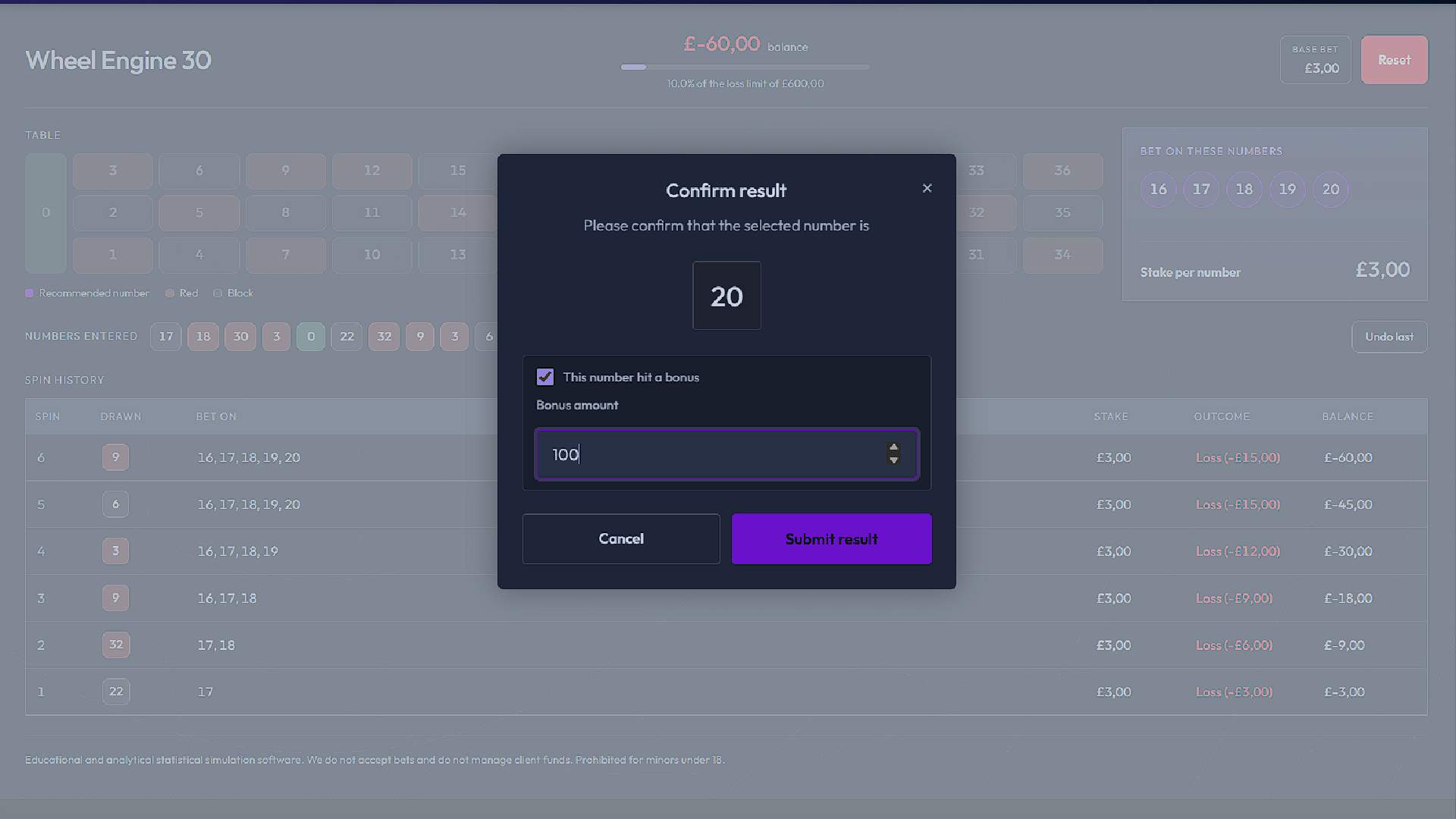
Wheel Engine 30 (Roulette Bonus Detector) is a straight-up roulette staking system that recommends up to six numbers per spin from your live spin-sequence input, sized against a locked base bet and loss-limit multiplier (x30 bonus roulette or x36 standard). It tracks your running balance, computes a live risk indicator against your configured loss limit, and — in x30 bonus mode — records bonus hits alongside each result, keeping your full session history in one place.
Main Features
- Live Risk Bar: Real-time indicator of how much of your configured loss limit has been consumed, colour-coded from green to red.
- Locked Base Bet: Base bet and multiplier (x30 bonus / x36 standard) are set once per session and can't be changed mid-progression.
- Multi-Number Recommendations: Suggests up to six numbers per spin based on the full drawn-number history.
- Bonus Tracking: In x30 mode, records bonus hits per spin alongside win/loss and running balance.
- Full Spin History: A complete spin-by-spin table of numbers, stakes, outcomes and balance for review.